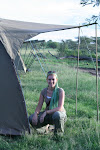
It's been nearly a month since i've gotten back to the states, and after some thought I have decided to continue writing... at the very least, writing down my thoughts and experiences once a week or so will keep me on my toes :). I'm on a Surgical ICU rotation right now, at NJMS-Newark (it's a trauma ICU, so for the moment that's keeping me very busy...), but i'll be able to get back to a more regular schedule of writing in a few weeks. For now, I wanted to share a few poems that I wrote while I was in South Africa... the first deals with the inevitable love (what's a chick website without at least one love poem, right?) and the second... well... you can figure it out. Thanks for the reading, i'll be back online and writing shortly!
Oh, and I also wanted to let everyone know that I have new photographs of Soweto on my photography site... just go to www.pbase.com/quideam.
US
A moment with you
And I'm lost.
An eternity runs past
And I do not notice.
Time
It pulls you away
Too suddenly
Too quickly
But a moment with you
And I'm lost.
Time cannot seep
Into us.
SORRY
I bleed for you,
Dark crimson pouring out.
Contractions clutch my soul,
And shove it down my throat,
And on the floor.
And there it is.
I look down and it's you.
My insides are outside,
Coffee grounds and tomato paste,
Salt water and crushed ice.
I'm bleeding with you,
Drowning in me.
And then you're gone.
I wasn't ready yet.
I'm sorry, my child, I wasn't ready yet.
Sunday, June 8, 2008


Thursday, May 8, 2008
Happy Birthday
Yesterday was Israel's 60th birthday, marked by numerous celebrations commemorating the nation's struggle for independence in 1948. I wrote a poem (posted below) to commemorate the continued struggle towards a truly democratic, peaceful nation that can be celebrated by all of Abraham's sons and daughters.
Birthday
Toddler in men's trousers,
Sucking your thumb through a cocked pistol.
Is the trigger in your mouth?
But you're pointing it at me.
Ancient stains on a tainted land -
Did He keep His promise?
Birthright through bloodshed,
And no one to tell the emperor he's naked.
The keys to the temple are here,
But we search in darkness.
Where did we meet last we found each other?
Take my hand, my brother.
Sixty candles coated in honey,
But the milk is burning.
Can you see?
Can you see me?
Birthday
Toddler in men's trousers,
Sucking your thumb through a cocked pistol.
Is the trigger in your mouth?
But you're pointing it at me.
Ancient stains on a tainted land -
Did He keep His promise?
Birthright through bloodshed,
And no one to tell the emperor he's naked.
The keys to the temple are here,
But we search in darkness.
Where did we meet last we found each other?
Take my hand, my brother.
Sixty candles coated in honey,
But the milk is burning.
Can you see?
Can you see me?
Tuesday, April 29, 2008
Night
5 am and we're hurtling through the streets of Soweto. Brush fires blaze in the background as shadowy figures huddle around them for warmth, thick blankets wrapped tightly around thicker waists, infants rocked to sleep on their backs. Bitter whiskey runs freely between young men patrolling the streets with bats; barely old enough to shave, they are marching with an uneasy certainty. Metallica's "For Whom the Bell Tolls" blasts from our radio. I open the car window as Francois lights another cigarette, and the wind is deafening.
'Princess' is a squatter camp rocking on the edge of chaos; it is a place of cramped shacks, raw sewage, and bullets. I wear an over sized bulletproof vest over my jacket, aware that its frayed belly is more for show than any real protection. Francois offers me a hand as we pass over a rickety bridge haplessly built on an open sewer; I do not need it, it is not the first time that I have passed through nightmares. Quietly, we make our way to a tiny shack, barely the size of a western bathroom, nestled in the heart of the camp. There is no crowd, only a small girl standing outside, lost in a dark blue blanket; a fat officer with faraway eyes idles restlessly nearby. We walk inside. There is a woman sitting on a bed. She is young and frail with high cheekbones and slightly sunken eyes; she clutches a bottle of milk and doesn't look at us. Her three month old daughter is lovingly wrapped in a blanket beside her, tiny coarse curls matted against her forehead. She wears a tiny pink hat that nearly covers her eyes, startlingly long eyelashes peeking out. We stay only briefly. We don't talk to the mother. As we leave, we ask the officer to translate for us. "Please tell her that the baby is dead", we say. We file a report and leave, drive away, faster and faster in the darkness. Far in the distance, beyond the dry hills and isolated roads, Soweto is burning.
I have written a lot about God in this past year, generally to reflect on his absence. The problem of evil haunts me: how could a benevolent God allow the horrors I see all around me? Perhaps worse, how could he blind so much of the world to the suffering that is so obvious it shakes me to the core, keeps me awake at night? There is so much pain, and for what reason? For a long time I have not believed in God. Rabbi Hillel said that most people live their lives in an easy darkness, unaware of their blindness. A few, however, are tormented by lightning: occasional flashes of realization that light up the earth and shake them from complacency. My experience this year has been one long lightning storm; sometimes it is a nightmare that I cannot wake up from, but other times I'm glad, because I am no longer sleeping.
I suppose that it would have been easy for God to make people good, to always make the right choices and create a happy world. But instead of goodness, God gave us an even greater gift: he gave us freedom. Uniquely, we have the ability to analyze and reflect, thereby making genuine choices. Those decisions will not always be right or just, and humanity as a whole has suffered for it. Greed, hatred, bigamy, ignorance... they plague us as a people, and yet most of the time we continue to walk in darkness, blissfully unaware of the evil we have allowed ourselves. But God in his wisdom has in fact given us two gifts: Free will, and Insight. I believe in God because I have seen the lightning; I have felt the truth and am blessed with the ability and opportunity to bring change, however small. It is a challenge that we all must answer, each in our own way. My time in India and Africa has been illuminating... I am coming home with enough thoughts to write without stopping until the end of my days. There is so much to see, to do, to experience and to change that it is nearly overwhelming... I take deep breaths and continue on, small steps and one at a time.
Thank you to everyone I have worked with - all of the amazing people and organizations that have made this year possible. You have enriched my life beyond belief, and I hope that in the years to come I prove worthy of the opportunities you have granted me. I have two more weeks in South Africa, mostly on holiday, but I will continue to write. After all, there is so much more to say. I am sitting here now, listening to the familiar Metallica tune that blasted on the radio a few nights ago in the paramedic response car. The deafening instruments do not drown out the original inspiration, Jon Dunne's 16th century poem in which he famously wrote that "any man's death diminishes me, because I am involved in mankind, and therefore never send to know for whom the bells tolls; it tolls for thee."
'Princess' is a squatter camp rocking on the edge of chaos; it is a place of cramped shacks, raw sewage, and bullets. I wear an over sized bulletproof vest over my jacket, aware that its frayed belly is more for show than any real protection. Francois offers me a hand as we pass over a rickety bridge haplessly built on an open sewer; I do not need it, it is not the first time that I have passed through nightmares. Quietly, we make our way to a tiny shack, barely the size of a western bathroom, nestled in the heart of the camp. There is no crowd, only a small girl standing outside, lost in a dark blue blanket; a fat officer with faraway eyes idles restlessly nearby. We walk inside. There is a woman sitting on a bed. She is young and frail with high cheekbones and slightly sunken eyes; she clutches a bottle of milk and doesn't look at us. Her three month old daughter is lovingly wrapped in a blanket beside her, tiny coarse curls matted against her forehead. She wears a tiny pink hat that nearly covers her eyes, startlingly long eyelashes peeking out. We stay only briefly. We don't talk to the mother. As we leave, we ask the officer to translate for us. "Please tell her that the baby is dead", we say. We file a report and leave, drive away, faster and faster in the darkness. Far in the distance, beyond the dry hills and isolated roads, Soweto is burning.
I have written a lot about God in this past year, generally to reflect on his absence. The problem of evil haunts me: how could a benevolent God allow the horrors I see all around me? Perhaps worse, how could he blind so much of the world to the suffering that is so obvious it shakes me to the core, keeps me awake at night? There is so much pain, and for what reason? For a long time I have not believed in God. Rabbi Hillel said that most people live their lives in an easy darkness, unaware of their blindness. A few, however, are tormented by lightning: occasional flashes of realization that light up the earth and shake them from complacency. My experience this year has been one long lightning storm; sometimes it is a nightmare that I cannot wake up from, but other times I'm glad, because I am no longer sleeping.
I suppose that it would have been easy for God to make people good, to always make the right choices and create a happy world. But instead of goodness, God gave us an even greater gift: he gave us freedom. Uniquely, we have the ability to analyze and reflect, thereby making genuine choices. Those decisions will not always be right or just, and humanity as a whole has suffered for it. Greed, hatred, bigamy, ignorance... they plague us as a people, and yet most of the time we continue to walk in darkness, blissfully unaware of the evil we have allowed ourselves. But God in his wisdom has in fact given us two gifts: Free will, and Insight. I believe in God because I have seen the lightning; I have felt the truth and am blessed with the ability and opportunity to bring change, however small. It is a challenge that we all must answer, each in our own way. My time in India and Africa has been illuminating... I am coming home with enough thoughts to write without stopping until the end of my days. There is so much to see, to do, to experience and to change that it is nearly overwhelming... I take deep breaths and continue on, small steps and one at a time.
Thank you to everyone I have worked with - all of the amazing people and organizations that have made this year possible. You have enriched my life beyond belief, and I hope that in the years to come I prove worthy of the opportunities you have granted me. I have two more weeks in South Africa, mostly on holiday, but I will continue to write. After all, there is so much more to say. I am sitting here now, listening to the familiar Metallica tune that blasted on the radio a few nights ago in the paramedic response car. The deafening instruments do not drown out the original inspiration, Jon Dunne's 16th century poem in which he famously wrote that "any man's death diminishes me, because I am involved in mankind, and therefore never send to know for whom the bells tolls; it tolls for thee."
Saturday, April 19, 2008
Pesach
This Passover, as we commemorate the Jews' liberation from over two centuries of slavery, let's not forget those who are still enslaved by unthinking foreign policies and bad government. As demands for biofuels increase and food prices rise, the frankly horribly predictable problem of worldwide hunger is growing at a faster rate than ever in the past three decades.
If Not Now, When?

What happens to a dream deferred?
There is a famous poem by Langston Hughes written around the time of the Harlem Renaissance called "A Dream Deferred"... Hughes asks, "what happens to a dream deferred? Does it dry up like a raisin in the sun? Or maybe it just sags like a heavy load... or does it explode?". Soweto, in may ways, is the answer to that question and its aftermath: What happens to a population that has been systematically repressed for so long, their dreams whittled down to aspirations for the basic human rights of recognition and equality? And, even more so, what happens when those dreams finally come true?
I went to Soweto last weekend as part of a small tour group run by Imbeza tours. The woman running the operation, Mandy, was engaging and provocative, immediately honing in on our interests and pushing for dialogue. Almost as soon as I got into the van, she started up a conversation about South Africa's politics and economic situation... she remarked that S. Africa's economy was growing too quickly. Now, this opinion took me by surprise, of course, because according to pretty much any political/ economic journal, S. Africa's economy is growing at a much slower rate than anticipated. Originally, when the ANC came to power, there was a lot of speculation about which way the country would go - would it descend into eventual chaos, like Zimbabwe, or would it putter and struggle along, eventually becoming a free democracy? Although civil war hasn't broken out, the ANC's economic and social policies, while on some level idealistically successful, haven't really panned out when it comes to market growth. Domestic companies are frustrated with the black empowerment laws that force them to hire certain percentages of non-whites for "leadership" positions, without simultaneously ensuring that the black work force is also educated enough for those positions. International companies, generally weary of Africa, seem to still be watching what happens... China is, in fact, quickly moving in to fill that gap, but the economic progress is nonetheless not as, well, progressive as it should be. Nelson Mandela, when touring Europe a few years ago and meeting with world leaders was asked why, amidst all the praises, these leaders aren't doing anything more to help South Africa develop. He replied, "they don't have any ink in their pens". The whole world seems to know that this country isn't doing as well as it should be... so why does Mandy think it's growing too quickly?
Mandy's answer touches on the frustrations that must be felt by many South Africans - when change comes, why doesn't it take them along? She reflects that the international companies establishing themselves in South Africa - opening banks, buying properties - are only benefiting those who are already part of the "white" system: in other words, only those who are educated and part of the current economic infrastructure are getting the jobs and, subsequently, an increase in their standard of living. But what about those who have been systematically excluded? During apartheid, the government made it official policy to provide purposefully poor education to the black communities - schools (shacks, really) would employ one teacher for more than a hundred students, and only the most basic materials were provided. Students would generally only study through primary school, afterwards joining the blue collar work force if they hadn't already dropped out. Only the wealthy few could afford a better education, and as a result illiteracy is widespread throughout even the most urban communities, such as Soweto. Since the ANC came into power the rhetoric has changed, but practical differences are barely noticeable. Public schools in Soweto are only improving slowly, and the funds that are supposed to be allotted to education and socioeconomic development in the poorest areas "disappear". The most frustrated seem to be the middle-class blacks: too "rich" for even meagre government subsidies, but without the resources to afford private education, how do they break into the system? What good is the end of political oppression if socioeconomic status remains the same, without any reasonable hope for change?
According to Mandy, the government should be focusing less on trying to appease foreign companies and recruiting more investors and instead put more efforts into education and housing. "But what about the tax revenues?" I asked... shouldn't the money that comes from investments be helping the poor? How else could the government get funding for the social programs she wants? Mandy paused and agreed with me that that was an interesting point... interesting, but not relevant because things aren't working that way in South Africa. Yes, taxes should be helping the poor - but they're not. They're either mismanaged, misappropriated, or simply disappear. But how could an economic slowdown possibly be the answer? Mandy pauses. "It would equal things out a little", she says after a while.
We drove through different neighborhoods, rich and poor, crossing the boundaries between million dollar houses and shacks in just minutes. We walked around, handed out food, and photographed. I saw the sights and sounds of Soweto that day - smelled chicken roasting on metal cans, tobacco wafting through ramshackle shebeens. But it is the soul of Soweto that I really wanted to see... Mandy gave me a window, but then the curtains closed and the tour was over. I got a glimpse of how the people must feel... it's unfair, things don't seem to change, when is it their turn? It's easy to say that I don't have those answers and, frankly, it's not my responsibility to know... I'm just here to stitch people up, right? As I uploaded photographs to my laptop that night, Rabbi Hillel's famous words resonated in the back of my mind "...If I am not for others, who am I? And if not now, when?".


Stark contrasts in living conditions between the rich and poor areas of Soweto, all black, ask questions that go far beyond the typical "race" dialogues

Young girl waits outside her house as a river of sewage runs past

Women cook chicken on a fire outdoors

Young girl pumps water... the poor neighborhoods of Soweto don't have indoor plumbing

Boy plays with a plastic gun... when do games become reality?

On the way to school

Elderly man relaxes in the late afternoon

Alcohol is a major problem in Soweto...
Thursday, April 17, 2008
Philosophical Diversion
Recently, I shared some of Bertrand Russell's writings with a friend; scanning his essays for the most meaningful, accessible bits made me excited about his work all over again... so much so that I feel compelled to post a small excerpt here. This is the preface to his autobiography, entitled "What I Have Lived For"... it is one of the most beautiful passages I have ever read, and it speaks to me deeply. Russel was a brilliant philosopher (yes, and mathematician...) in many fields, but it is his passion for self-reflection and honesty of vision that I admire most. In my opinion, one of the greatest pitfalls of 'modern' living is the ability to walk through life blind, without contemplation; it's easy to become well-fed shells going through the motions without ever looking deeper into ourselves. Russell not only embodied the antithesis of that, he lived its principles. Now, of course, the passage below, beautiful as it may be, is brief and inevitably superficial. But, it's 11am and I haven't slept in nearly 30 hours, so....
What I Have Lived For
Three passions, simple but overwhelmingly strong, have governed my life: the longing for love, the search for knowledge, and unbearable pity for the suffering of mankind. These passions, like great winds, have blown me hither and thither, in a wayward course, over a great ocean of anguish, reaching to the very verge of despair.
I have sought love, first, because it brings ecstasy - ecstasy so great that I would often have sacrificed all the rest of life for a few hours of this joy. I have sought it, next, because it relieves loneliness--that terrible loneliness in which one shivering consciousness looks over the rim of the world into the cold unfathomable lifeless abyss. I have sought it finally, because in the union of love I have seen, in a mystic miniature, the prefiguring vision of the heaven that saints and poets have imagined. This is what I sought, and though it might seem too good for human life, this is what--at last--I have found.
With equal passion I have sought knowledge. I have wished to understand the hearts of men. I have wished to know why the stars shine. And I have tried to apprehend the Pythagorean power by which number holds sway above the flux. A little of this, but not much, I have achieved.
Love and knowledge, so far as they were possible, led upward toward the heavens. But always pity brought me back to earth. Echoes of cries of pain reverberate in my heart. Children in famine, victims tortured by oppressors, helpless old people a burden to their sons, and the whole world of loneliness, poverty, and pain make a mockery of what human life should be. I long to alleviate this evil, but I cannot, and I too suffer.
This has been my life. I have found it worth living, and would gladly live it again if the chance were offered me.
.
What I Have Lived For
Three passions, simple but overwhelmingly strong, have governed my life: the longing for love, the search for knowledge, and unbearable pity for the suffering of mankind. These passions, like great winds, have blown me hither and thither, in a wayward course, over a great ocean of anguish, reaching to the very verge of despair.
I have sought love, first, because it brings ecstasy - ecstasy so great that I would often have sacrificed all the rest of life for a few hours of this joy. I have sought it, next, because it relieves loneliness--that terrible loneliness in which one shivering consciousness looks over the rim of the world into the cold unfathomable lifeless abyss. I have sought it finally, because in the union of love I have seen, in a mystic miniature, the prefiguring vision of the heaven that saints and poets have imagined. This is what I sought, and though it might seem too good for human life, this is what--at last--I have found.
With equal passion I have sought knowledge. I have wished to understand the hearts of men. I have wished to know why the stars shine. And I have tried to apprehend the Pythagorean power by which number holds sway above the flux. A little of this, but not much, I have achieved.
Love and knowledge, so far as they were possible, led upward toward the heavens. But always pity brought me back to earth. Echoes of cries of pain reverberate in my heart. Children in famine, victims tortured by oppressors, helpless old people a burden to their sons, and the whole world of loneliness, poverty, and pain make a mockery of what human life should be. I long to alleviate this evil, but I cannot, and I too suffer.
This has been my life. I have found it worth living, and would gladly live it again if the chance were offered me.
.
Sunday, April 13, 2008
Personal Statement!
Hey everyone, and thanks for reading... apologies for not updating the blog for the last week, I've been busy working (ok, just a little!), abseiling, caving, hiking, and... working on a personal statement! I need to submit a mini essay on "why I want to be an emergency medicine physician" to USC/Keck School of Medicine in order to do a rotation there... this morning I woke up with a little inspiration and finally wrote something! I pasted the statement below... please post or email comments, as I would *love* all and any feedback! I'm submitting the essay sometime Tuesday afternoon, so please send comments by then! Thanks a lot, and I promise more updates this week!
*****
Thank you for the input to everyone who emailed/ posted comments... more updates to come soon!
*****
Thank you for the input to everyone who emailed/ posted comments... more updates to come soon!
Subscribe to:
Posts (Atom)