Saturday ended the same way it began: with death.
I left for Mumbai on Thursday, intending to spend the Rosh Hashanah weekend in the city, shopping and eating pastries. Instead, I went back to Palghar early Friday morning when Shashi, who was watching Moti while I was away, phoned to say that he seemed very sick. Coming home, I found a lethargic puppy with deep, sad eyes; he had refused to drink or eat anything for the past day. I ran around frantically, trying to find a veterinarian. You might think that this is a relatively easy task, considering all of the dogs and various livestock wandering the streets; you might think that, and you would be wrong. This being India, nothing is impossible, but almost everything is incredibly difficult. I searched online, called everyone I knew, went out on foot in the blistering sun; I begged, pleaded, offered money, then more money; I cursed unintelligible Marathi signs and indifferent fruit vendors. Finally, with help from Impact, I found a vet who arrived with a dingy metal medical bag three and a half hours late. In the interim, Moti had had two episodes of bloody diarrhea; dark, maroon blood, the kind that soaks deep into your consciousness and makes your heart beat faster. Moti didn't go on the floor; he was so intelligent and so dignified that even at his weakest, he made the effort to walk outside the apartment and emptied his bowels on my neighbor's welcome mat. He then teetered back to me and lay his small furry head in my lap.
The veterinarian smiled at me and gave the dog two shots of antibiotics. I told him, anger mixed with exhaustion, that I'm a doctor, demanding to know what he was giving him and what he thought was wrong. In India, as in Russia, doctors don't feel a need to inform their patients, or the patients' relatives, of what's happening; they are the "experts" and we should be happy to defer to their judgement. I certainly wasn't happy, and was getting less so by the minute; I got a prescription for some ayruvedic medicine and oral ciprofloxacin, which Moti would later vomit all over the floor. I stayed up with him all evening and half the night, forcing him to drink rehydration solution through a pipette and reasurring him with gentle petting. He lay calmly on my lap, looking up at me occasionally. Sashi thought he looked better; I thought his eyes were tired, resigned. I let him sleep in my bed, neatly curled up in a ball. At some point, in the middle of the night, he got up to vomit again nearby and stumbled out of my room. I found him, early in the morning, peacefully asleep on the kitchen floor, his body rigid and soul-less. We buried him in an empty, grassy field near Impact's office. I buried him with his blanket and a small Star of David I found in my jewelery bag. I threw dirt on his grave until my vision was blurry and my throat was raw.
I cried all afternoon, and then took the train back to Mumbai in an effort to escape the emptiness, even for a little while.
Crushed in a muggy train car, pale yellow walls peeling into rust, dusty, dead fans hanging overhead, I can barely move, barely breathe. We are not people, we do not have personalities or identities; we are just bodies, pushed together, until the only available space is outside the train, and even there other bodies are hanging on. I'm trapped between a young woman in a brightly decorated red sari and a peculiarly large, black plastic suitcase. I am soaked, I cannot feel my feet, I'm dizzy and hot and oh-my-god-i-have-to-get-out-now-please-now!! I think I am delirious, I'm daydreaming that the woman is a spy and the black suitcase contains nuclear weapons, that the crippled beggars are just actors and the baby crying next to me will stop sometime. I manage to pull a bottle of water from my bag and take a sip; it's hot, it tastes like stale biscuits, it tastes like India. An elderly woman on a bench across from me gazes at the water with familiar, resigned eyes; I give her the bottle and am resigned myself.
I'm angry and exhausted. India killed Moti, and it's killing me. The suffering is overwhelming, and I cannot be shielded from it; I have thrown myself in, deeply, and I cannot get out. I feel like i'm drowning in the enormity of what's around me; every beggar, every dirty child, every cripple, stray dog, every cracked street corner reminds me that I did not save Moti because I could not save him, because we are in India and in India we all die a little every day. I cannot give money to every dusty child, but even if I could, I cannot feed them, clothe them, and love them. I cannot offer a home to every puppy or grass to every cow; I cannot, and the government does not, and it's killing me. I'm not sitting in an air conditioned room reading the newspaper; I'm in the field, I'm involved, and still, perhaps more so, I am complicit to the suffering. I thought that it was difficult to look at disasters and suffering from afar, to study abstract scientific principles while people suffered and died from very concrete diseases. It is even more difficult being here, emtpy-handed no matter how much i'm holding.
I went to dinner with Neelam and her friends on Saturday. They discussed the NGO, its' future directions. Neelam wants every Adivasi village to have a computer so that they can record their immunization records and other health data. One of her friends, a leader and community organizer within Mumbai's slums, argues that computers only encourage inaccuracy, that people come in from the outside with their laptops and type in unsubstantiated data that cripples the communities. They ask for my opinion. I say that I object on the basis that the Adivasi villages don't have electricity. I say that and I laugh; I think they're insulted but I'm far from caring. Are we really sitting around, talking about bringing laptops to a population that does not understand the basics of hygiene? Are we really discussing the internet when we should be worrying about sanitation and education? The room spins around me and I think I might be sick. Here are the people who make the decisions, and even here, in the middle of "reality", we are discussing what are, in essence, abstractions. The very same abstractions I'm feeling, i'm falling into, an unwilling participant in the inane decision-making that seems to be inherent in India. Nothing is difficult, almost everything is impossible, and very much won't change.
I walked for a long time along the shore, but did not see the water. I got sand in my shoes but didn't feel the grains cutting my soles. I took a photograph of a balloon vendor, but don't remember his face; an Indian asked me why "we" always take pictures of poor Indian people, and I had to stop myself from hurtling my camera at him. It is not the pictures, not the words or the labels or the newspaper articles blandly discussing the horrors of poverty. It is the people, all of us, here and now, walking the streets of India, seeing the horror, and continuing on. I couldn't save Moti because he is a product of India; a product of corruption, chaos, struggle, misunderstanding, and grief. There is a lot of beauty in India, a lot of hope amidst the rubble, development and progress amongst the backward. But Moti died despite my greatest efforts, and he took a bit of me with him; I'm hot and tired and angry at the helplessness. I am in India, dead in India, and when my body steps onto another train tomorrow I will not feel it. I guess this is how India continues on.
Sunday, September 16, 2007


Thursday, September 13, 2007
Shana Tova
The evening started off normally enough, considering it was the eve of Rosh Hashanah and I was sitting in the basement of Keneseth Eliyahoo, Mumbai's oldest and possibly most dilapidated synagogue, surrounded by dusty sidurs and the faint sound of cows and taxis trickling in through an open stairwell. The 14 of us - myself and 13 peculiar looking gentlemen (there was one European-looking guy at the beginning, but he gave up and left halfway though) - sat around a wooden table covered with a cheese-themed tablecloth; me, sneaking peeks; them, staring shamelessly. Two hours of mumbled prayers, made all the more unintelligible by the thick Hindi-accented Hebrew of the rabbi leading the services (i'm assuming he was the rabbi, as he was the fattest, loudest, and had a peculiar style of wild curly hair vaguely reminiscent of a pigeon's nest after a storm). Afterwards, we were served sweet fuzzy fruit with chai, and in my infinite wisdom, i decided to socialize by striking up a conversation with the young-looking guy sitting next to me. Wearing a dark, Sephardic kippa and diligently following all of the Hebrew, he had been engrossed in his sidur the entire time and had therefore managed to be the least creepy of the bunch (he also had teeth - that's a big plus).
After brief introductions, an awkward conversation, even by Indian standards, ensued...
Johan: So, what do you do?
Me: I'm a medical student, working with an NGO
Johan: I'm in the medical field also, I work for an Aloe Vera distributor
Me: Oh, how interesting. What do you do with them?
Johan: It's really a great job, you know, it's a very unique company. And I can work anywhere.
Me: Oh, great, ok.
Johan: ... and i really like it, you know, we do such great things with it, we sell it everywhere...
Me: Right... ok, that's nice... (i look away)
Johan: ... and we don't have cubicles, and it's really great, aloe vera can be used for anything...
Me: Mmmhmm (shifting uncomfortably)
Johan:So. Are you married?
Me: Um.... no.
Johan: Neither am I. You should give me your email.
Me: Oh, yeah, uh, sure, ok...
Johan: I can show you around Mumbai. We'll go out together.
At this point, we had left the synagogue and started our walk towards the "Gateway to India" where we (or, really, the loud rabbi-like creature) would say some prayers over the water. On the way, Johan and another congregation member, Samuel, competed for my attention with such stimulating questions as "what's your sign?" and "would you like to get married soon?". Luckily, my well-honed survival skills didn't fail me and I was able to inconspicuously sneak away into the crowd, email and marital preferences undisclosed. Taking a long walk by the water, my beaded salwaar glistening in the fading sunlight (ahh), I breathed a sigh of relief. Walking past, a middle-aged man in a kippah commented, "you look great in the Indian costume! Where are you from?" and proceeded to stop as I hurried by.
So, my impression of Jewish life in India thus far? It's a great singles scene, if you go for the awkward and toothless! On a serious note, although there are an estimated 5,000 Jews living in the Mumbai area, I saw very little sign of a bustling community; even on Rosh Hashana, one of the most festive and celebrated holidays, only a few random people showed up for services; granted, it's probably a higher percentage than we get in New York, but it's obvious that Jewish life, in this area at least, is a dying tradition.
There is another thought in my mind tonight... going to a synagogue in an Indian dress, it struck me that 'identity' is really just the mishmash that you throw together, the relatively random set of values and traditions that make you feel comfortable. The obsession with "Indian or not" and "Jewish or not" that surrounds me every day is irrelevant if you look at the bigger picture - who you are has been shaped by everything you've experienced, and so much of that has been out of your control. So you are who you are, partly due to your own choices, and mostly thanks to the randomness of the universe. Who ever thought I'd be celebrating Rosh Hashanah in Mumbai? And who ever thought it would be the most perfect day, peculiar proposals and all? Identity, in my opinion, is largely a state of mind, and so is deciding how you feel about it. I have always been deeply troubled by own lack of roots, by not feeling that i'm truly a part of something in particular... but the longer I spend in India, the more I understand that the best identity isn't the one you fall into by birth, but the one you choose in the great sea of experiences available, waiting to be savored. Tonight I celebrated a Jewish holiday; Saturday, I will be celebrating the beginning of Maharasthra's major Ganesh festival; all around me, women in black robes are observing Ramadan. Slowly, my goal changes... it is no longer a quest for firmer footing... i'm learning to savor the waves of being an international citizen, making my own path through the uncharted waters. It isn't an easy journey, but it's certainly worth it.
After brief introductions, an awkward conversation, even by Indian standards, ensued...
Johan: So, what do you do?
Me: I'm a medical student, working with an NGO
Johan: I'm in the medical field also, I work for an Aloe Vera distributor
Me: Oh, how interesting. What do you do with them?
Johan: It's really a great job, you know, it's a very unique company. And I can work anywhere.
Me: Oh, great, ok.
Johan: ... and i really like it, you know, we do such great things with it, we sell it everywhere...
Me: Right... ok, that's nice... (i look away)
Johan: ... and we don't have cubicles, and it's really great, aloe vera can be used for anything...
Me: Mmmhmm (shifting uncomfortably)
Johan:
Me: Um.... no.
Johan: Neither am I. You should give me your email.
Me: Oh, yeah, uh, sure, ok...
Johan: I can show you around Mumbai. We'll go out together.
At this point, we had left the synagogue and started our walk towards the "Gateway to India" where we (or, really, the loud rabbi-like creature) would say some prayers over the water. On the way, Johan and another congregation member, Samuel, competed for my attention with such stimulating questions as "what's your sign?" and "would you like to get married soon?". Luckily, my well-honed survival skills didn't fail me and I was able to inconspicuously sneak away into the crowd, email and marital preferences undisclosed. Taking a long walk by the water, my beaded salwaar glistening in the fading sunlight (ahh), I breathed a sigh of relief. Walking past, a middle-aged man in a kippah commented, "you look great in the Indian costume! Where are you from?" and proceeded to stop as I hurried by.
So, my impression of Jewish life in India thus far? It's a great singles scene, if you go for the awkward and toothless! On a serious note, although there are an estimated 5,000 Jews living in the Mumbai area, I saw very little sign of a bustling community; even on Rosh Hashana, one of the most festive and celebrated holidays, only a few random people showed up for services; granted, it's probably a higher percentage than we get in New York, but it's obvious that Jewish life, in this area at least, is a dying tradition.
There is another thought in my mind tonight... going to a synagogue in an Indian dress, it struck me that 'identity' is really just the mishmash that you throw together, the relatively random set of values and traditions that make you feel comfortable. The obsession with "Indian or not" and "Jewish or not" that surrounds me every day is irrelevant if you look at the bigger picture - who you are has been shaped by everything you've experienced, and so much of that has been out of your control. So you are who you are, partly due to your own choices, and mostly thanks to the randomness of the universe. Who ever thought I'd be celebrating Rosh Hashanah in Mumbai? And who ever thought it would be the most perfect day, peculiar proposals and all? Identity, in my opinion, is largely a state of mind, and so is deciding how you feel about it. I have always been deeply troubled by own lack of roots, by not feeling that i'm truly a part of something in particular... but the longer I spend in India, the more I understand that the best identity isn't the one you fall into by birth, but the one you choose in the great sea of experiences available, waiting to be savored. Tonight I celebrated a Jewish holiday; Saturday, I will be celebrating the beginning of Maharasthra's major Ganesh festival; all around me, women in black robes are observing Ramadan. Slowly, my goal changes... it is no longer a quest for firmer footing... i'm learning to savor the waves of being an international citizen, making my own path through the uncharted waters. It isn't an easy journey, but it's certainly worth it.
Friday, September 7, 2007
Huts, monsoons, and a new friend
Wading through knee-deep mud puddles and sheets of stubborn rain, tightly covering my hair with the drenched dupatti, I suddenly thought to ask, "are there snakes in these waters?" Squish squish squish... George cocked his head and thoughtfully replied, "I don't think so... at least, not poisonous ones... well, probably not". I raised an eyebrow and looked down, just in time to avoid a wandering chicken.
I spent the past two days with staff from IIF visiting remote villages in the Thane District. In Maharasthra, there are tribal people, called Adivasis; they are the indigenous inhabitants of this area who, over the years, have been marginalized by mainstream Indian society. Although Indians in even the most rural places may have brick homes and motor vehicles, the Adivasis still maintain their traditional lifestyle: people live in mostly wood and straw huts and thrive off of subsistence farming or fishing. Walking (or wading) through the villages, I feel that I have entered a different world - chickens and goats run around freely, women carry baskets and dishes on their heads, and children cover their hair with giant leaves for protection from the rain. IIF works in these areas to promote better access to healthcare, including vaccination campaigns, family planning, nutrition, and hygiene. They also work to encourage primary education for children and the formation of women's self-help groups in which the women are encouraged to save money together towards common goals, such as buying land or starting up small businesses selling fruit or making handicrafts. Unfortunately, there is a great deal of work to be done - hygiene is poor, and although physicians are available, people's education and health awareness is lacking, so that children often die or suffer serious complications from preventable and treatable diseases. As we traveled around, people heard that an "American doctor" was visiting (talk about pressure!!) and started showing me their children; some of the things I saw were disturbing to the point that I insisted we take them to a hospital immediately. Amongst many problems, I saw several children with incredibly bad scabies (dark, papular rash all over their bodies); a few had scratched the rash to the point of creating open wounds, allowing bacterial infections to cover arms and legs. In the end, we did manage to convince them to take a few of these children to the doctor, but clearly, major interventions are necessary to give these children proper care.
One of my main projects with Impact India is continuing the first aid training program started by Dr. Christine Zink when she was here two years ago. By visiting the tribal communities and meeting with local health workers, physicians, and traditional healers, she developed a basic first aid manual addressing common problems seen in this population. Some of the guide was later translated into Marathi, but the training was difficult because the majority of Adivasis are illiterate. After seeing the manual and discussing these difficulties, I came up with an idea for rejuvinating the program and, hopefully, making it more effective. The Adivasis have a tradition of art, called Warli art (see the sample below); in every village, everyone from children to 'professional' artists create these drawings, depicting daily life and special events, such as harvesting and marriage. IIF has used this art to convey some of their health messages, such as the benefits of later marriage and breastfeeding. My idea is to take a few of the most important topics from the first aid manual and develop drawings illustrating the concepts; then, through a translator, I would be able to teach these ideas to villagers using the drawings as both instructional tools and as a way for them to remember the information later. We decided to target the women's self-help groups for the training, conducting 1 hour sessions for 20-25 women at a time. Although there are many important first aid topics, I carefully chose four on the basis of simplicity, ease of illustration, and relevance. The subjects are: (1) diarrhea and rehydration therapy, (2) snake bites, (3) burns, and (4) recognizing severe illness in small children. If I find that I have extra time, I will also discuss common, non-emergent conditions, such as lice and scabies.

Traditional Warli art
Luckily for me, IIF has a permanent Warli artist on staff; I have already discussed my ideas with him, and he has produced some preliminary drawings for field testing. I have spent the last two days traveling to villages, asking the Adivasi women for feedback. Over the next two weeks, we will develop a final set of drawings, which will be made into large posters and smaller handbooks to be handed out to the women during the training. With the help of George (who runs several of the healthcare projects), I have networked with several village physicians, and already have a list of about 100 women who can undergo the training. Once the drawings have been finished and printed, the planning will become logistical - some of these villages are hours away, and I will need to arrange for a driver and an interpreter. However, Dr. Dhir (the physician working with IIF) and George are encouraging, and assure me that we will be able to make this work. As always in India, i'm wary of promises, but Impact has been incredibly helpful so far, so i'm keeping my fingers crossed! This project is turning out to be quite a challenge, and it's absolutely thrilling to be developing something that both embraces the local culture and, hopefully, provides an innovative solution to an important problem.
In other news... I have adopted a puppy! I was walking around Palghar with Priyanka tonight (in search of fabric and nose rings), when i saw this little guy walking through garbage. He looked so sad and sickly; at the most, he's about 2 or 3 months old, and I decided that if I didn't take him home, he would most likely die of exposure and malnutrition. I washed him (he didn't complain!) and Priyanka brought him a little milk; although he drank some of it, he vomited most of it up later. Right now, he's sleeping peacefully in a corner with a cool dish of water by his side; tomorrow, we're going to look for a veterinarian (I suppose this would be a good time to start learning doggie medicine!). I've named him Moti; in Hindi, it means "little pearl", and in Hebrew, "sweetheart"; looking at him, it's just perfect. I don't know how long i'm going to keep him for, but i'm going to try to nurse him back to health (with vaccinations and all, if possible) before letting him back on the streets. Wish me luck! (and, yes mom, i'm washing my hands a lot :).
Wednesday, September 5, 2007
It rained all night... persistent, heavy, hollow... taptaptap... the kind of rain that wakes you, surrounds you, makes you feel its' rhythm... For a while, it forced the heat to release its grip, sending it off to rise above the whirring of my fan, above the snoozing cows and scrap metal roofs, up and up to linger restlessly in the clouds. It was 6am and I lay awake, mesmerized. The rain continued, welcoming the dawn and the day, swishing the mud and casting a cool mist over my pale green silvar kamees. I rode my moped through the streets, splashing, evading, loving the breezy droplets rushing over my shoulders. My hair drenched, fresh mud caking my sandals, I stepped off the bike and went inside to begin a new day...
The rain washes away many things, leaving behind enough to remember while clearing the path for new memories. Robert Frost said it best, reflecting "one thing I've learned about life: it goes on". And, so it does. I celebrated Krishna's birth at midnight... even for a small, rural temple, the jubilation pounded in my ears with the strength of an orchestra. My surroundings are a constant reminder that the remarkable beauty of this country, even in the shadow of poverty and illiteracy, is a representation of unprecedented hope, of constant rebirth. I feel it all around me, and am grateful to experience such humanity.
India, for all its' difficulties and inconsistencies, is wonderful. Some days i feel like I'm living in an episode of National Geographic, but other days I just feel like I'm living, and that's the best feeling in the world.
Monday, September 3, 2007
Moving on up!
To those of you who think i'm really roughing it, who worry about what i'm eating and where i'm sleeping... consider this: My new apartment has broadband and cable television, and I just finished a delicious meal of fresh garlic naan, vadas, and raita from the restaurant downstairs. So... welcome to the expat NGO life, such as it is.

I spent the weekend in Mumbai with Neelam; we had a wonderful time exploring the city and going for long walks by the shore. Her apartment is in a more affluent part of South Mumbai, so although there were still cows wandering about, they were immaculately groomed and well mannered (just kidding... but really, it's quite a nice area; much more of a 'hey, i'm in a strange European city' feeling than 'wow i'm in national geographic!'). One of the nights, we went to dinner at her friend's house, a professor who had studied philosophy at Brandeis; we spent the evening discussing Popper, Milton, and epistemology over white wine and baked paneer. You know Thomas Friedman was right when an American-educated Indian can quote German philosophers and has a copy of Pushkin's poetry on his bookshelf...
This morning, I drove down to Palghar with Neelam and Zelma Lazarus, Impact India Foundation's CEO. The state of Maharasthra (the most populated in India) is divided into Districts. Each district is then divided into blocks, and each block contains an average of 100-200 villages. The village, called Palghar, is in Palghar block, within the Thane district (see map below; we're located just two hours north of Mumbai). The NGO has given me a great apartment in their building, just a 10 minute motorbike drive away from the office (that's right... i get a scooter!). Maharasthra, once you get out of Mumbai, is really quite rural; since we're right at the end of the monsoon season, the entire area is green and bursting with leafy plants and lively rivers. I'm lucky that my projects, while allowing me to live in the center of town, will also take me quite frequently to the isolated villages scattered amongst the greenery, as well as to local schools and primary health centers. I'm looking forward to exploring, photographing, and of course, more writing...

Map of Maharasthra state; Thane province is on the west coast, just above the "greater Mumbai" region
.
This evening, after settling in, I went shopping at the vegetable market... I bought bananas, pears, green peas, and some strange prickly red fruits that I was convinced would be incredible. I also got fitted for a pale green silvar kamees (a modern Indian dress), which, for about $8, will tailor-made and ready for me tomorrow (we're *really* not in New York any more, Toto!) Tonight at midnight i'm going with one of the girls from the NGO, Priyanka, to see the festivities celebrating the birth of Krishna. Everyone's really excited to show the foreigner around... and i'm certainly not saying no :).
.
I have to say, for all of the contradictions of India, the problems, dirt, poverty, bizarre traffic patterns... one thing that I have not experienced is disappointment. The people i'm working with are unbelievably kind and accommodating (at the restaurant, Neelam was very assertive about making sure that there were no peppers in anything!); although they have 'less', the hospitality i've seen here is rarely witnessed in the West. The colors of India, too, are even more evident in the villages; beautiful women in bright colored saris walk along the muddy roads as elegantly as debutantes at a ball; they carry baskets on their heads and backs with pride and grace, making my own careful footsteps for clumsy intrusions. Traveling all over the country, from the steep slopes of the Himalayas to the busy cities, and now, to the most rural of places, I have started to get a feel for India, a taste for the life and the culture. I have much to learn, and there are lessons everywhere; between the cows and street vendors, rickshaws and locomotives, India is lurking... you just have to be patient, wait to be welcomed in. It's midnight soon, and I can already hear the crowds outside my window... I don't need another invitation.
Girls just wanna have fun...
Hey everyone!! Thanks so much for keeping up with my blog, and I promise to post a real entry in a bit... but first, here are some more great photos from the HHE trip (and thanks so much to everyone who shared them on facebook!)

At Shingo-La Pass... we made it!

Examining a village woman... it was very strange, she just randomly came
up to me as I was walking to the village shop, wanting me to listen to her heart...

Shopping in Manali (hey, we deserve it!)

Aww... great group shot (but they all had funny accents ;)

After picking peas with the locals, i became known as the "pea lady"... I think

This is way harder than it looks!

At Shingo-La Pass... we made it!

Examining a village woman... it was very strange, she just randomly came
up to me as I was walking to the village shop, wanting me to listen to her heart...

Shopping in Manali (hey, we deserve it!)

Aww... great group shot (but they all had funny accents ;)

After picking peas with the locals, i became known as the "pea lady"... I think
Lindsey was jealous ;)

That's Tazo, or "poo doggie"... I just couldn't keep my hands off of this
furry little guy...

This is way harder than it looks!
Sunday, September 2, 2007
Mumbai
My last night in Delhi, the 29th, was spent visiting the Lotus temple in South Delhi... it's the major Baha'i center here, and I have to say, it's even more remarkable than the one in Haifa. Still, the Israeli one was the first, so still quite significant for its' history... quite ironic, considering the Baha'i origins are Iranian... but I suppose that point just illustrates how globalization can, at least sometimes, transcend intolerance.



I traveled from Delhi to Mumbai via a 17 hour, overnight train... not an entirely unique experience, but certainly an Indian one. We passed the most luscious green feilds and yellow plantations with billowing stalks of wheat and corn... we also passed villages that could have passed for refugee camps, carpeted with blue tarps and muddy roadways. I chatted with a man sitting across from me, and between drinking coffee and eating rice with daal, we managed to have some rather interesting conversations. Amongst other things, I learned that a university-educated mechanical engineer whose daughter is a physician can believe that traditional Indian medicine can cure AIDS and cancer... As always, I am subtley reminded that India is indeed an incredible juxtaposition.
Mumbai is quite a city... the shore, shops, and brightly lit skyline are unexpected, quite welcome reminders of home. Neelam met me at the train station; soft spoken, with calm brown eyes and gentle features, she has quickly become my surrogate aunt. She has been my contact for Impact India Foundation, the NGO that I will be working with for the next few months in Maharasthra. The organization works to strengthen government health programs as well as add their own innovative projects; they work primarily in the villages, and I will be working n Thane Province, in Palghar. I will have several projects, amongst them teaching first aid and emergency medicine principles to specially selected 'health monitors' in the schools, which i'm particularly excited about. In these regions, the vast majority of the population is completely uneducated and ignorant to even the most basic health practices; simple topics, such as rehydration and burn care, can be lifesaving. At the same time, I will be working on developing a manual for IIF's diagnostic mobile, and contributing to their plans for the health fair coming up in October. We leave for the village early tomorrow morning, so i've been using the weekend to relax, read books, and shower as often as possible. On a side note, if anyone's looking for a great book, I just finished "A Thousand Splendid Suns"... quite remarkable.
* * * * * * * * * * * * *
Healthcare in the Himalayas
Examining patients has an entirely different meaning if you're under a tree, in the mountains, and your patient doesn't understand why you need them to take their shirt off - both because they don't speak your language, and because an evil spirit has caused their pneumonia, not a bacteria. I give a great deal of credit to the translators who worked so diligently by our sides; their translations spanned not only languages, but also cultures and generations. In general, our setup was simple: in groups of 4-5 medical students, we worked with a physician to examine and diagnose patients; once everything was written down on a sheet of paper, the patient would carry their prescription to the 'pharmacy' - a table with scattered bottles and notebooks - and receive their medication.
Most commonly, the diagnoses were simple - patients had chronic osteoarthritis, exacerbated by long hours of manual labor; gastroesophageal reflux, exacerbated by spicy foods, or pterygium and watery eyes, due to working in the sun without sunglasses. Colds, warts, scabies, and headaches were endemic; ear infections and pneumonias, nearly so. Occasionally, we saw some interesting cases - congestive heart failure, orbital cellulitis, NF-1, even a schizophrenic. In the poorer villages, we saw malnutrition, most commonly in the form of iron deficency. In one village, a limp, sickly six month old was brought in; the mother, fifty years old, was unable to produce sufficient milk, and the child was being fed with butter tea - boiled water mixed with yak butter. Oral hygeine was also a problem; although toothpaste was widely available, not everyone used it, and the dentists on our trek performed many extractions.
Every night after clinic, we had a teaching session - lectures on infectious diseases, women's health, pediatric problems. We also discussed the logistics of the clinic, pharmacy, and general issues that had come up during the day. Overall, it was quite an experience, one that i'm sure I will be reflecting on for some time to come.
Below are some photographs of the pathology and our work.

Examining the cutest kid in the world... he just had had scabies

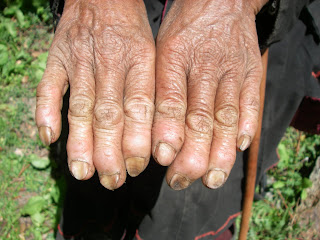
Take a look at the nails... classic sign of iron deciency

A modified dental chair for the cavity-prone... lots of crying from this station!

Taking a break with village women... by their early twenties, some of these
women have already had several children.

Our land cruiser, a god send! Towards the end of the trip, we were able
to utilize it to carry medicines and the occasional exhausted trekker...
Subscribe to:
Posts (Atom)